

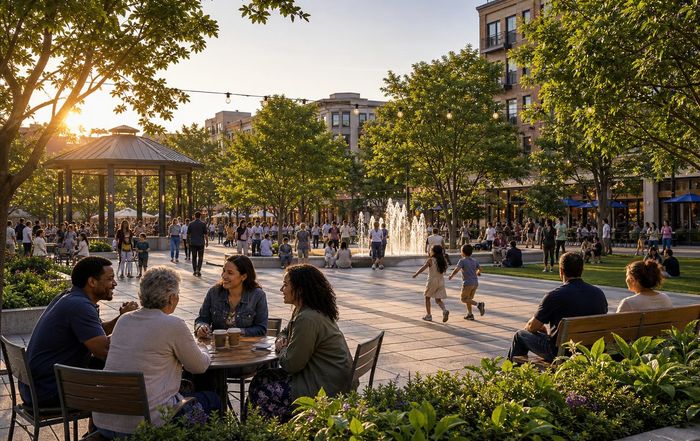
How Public Squares Help Cities Build Stronger Communities
Public squares are often treated as pleasant extras in city planning: nice to have if there is budget and leftover land. Yet research from urban sociology, public health, and economics increasingly suggests they are core infrastructure for social life, much like roads are for transport or pipes are for water. From historic piazzas in Italy to new waterfront plazas in North America and Asia, well-designed public squares consistently host the everyday encounters, rituals, and conflicts that make communities feel real rather than abstract. Understanding how these spaces actually work-and why some succeed while others sit empty-helps explain why cities around the world are reinvesting in them as tools for social cohesion, public health, and even democracy.
Why public squares matter in the age of digital connection
At first glance, it can seem that digital platforms have replaced the need for physical gathering places. Messaging apps, social networks, and video calls allow people to connect across continents, and many civic debates now play out on screens rather than in plazas. Yet urban researchers and organizations such as UN-Habitat argue that physical public space remains essential for inclusive, resilient cities, partly because it offers what online platforms struggle to provide: unplanned, face-to-face encounters among diverse people who share a place but not necessarily an algorithm. According to the World Health Organization's work on age-friendly cities, accessible public spaces are linked to lower social isolation, better mental health, and more active lifestyles, particularly for older adults.
In many cities, the most obvious examples of these spaces are central squares, plazas, and large open intersections that function as common "living rooms." They host markets, protests, festivals, and everyday loitering. They are where tourists first feel the mood of a city and where local residents notice subtle shifts in safety, culture, or inequality. For readers interested in how public environments shape wellbeing, these spaces sit at the intersection of health, society, and culture, offering a concrete lens on broad social trends.
The social science behind shared urban spaces
Urban theorists have long argued that public squares are engines of social life. The urbanist Jane Jacobs, writing in the 1960s, described how sidewalks and neighborhood parks create "eyes on the street," informal social monitoring that makes areas safer and more welcoming. Later, sociologist Ray Oldenburg popularized the concept of "third places"-settings that are neither home nor work, such as cafés, parks, and plazas-where informal public life flourishes. Public squares often function as especially visible third places because they are open to all, free to enter, and centrally located.
Contemporary research backs up many of these observations. Studies summarized by the Project for Public Spaces highlight that successful squares tend to generate high levels of "lingering," where people feel comfortable enough to sit, watch, and talk rather than simply pass through. This lingering correlates with more social interactions, stronger feelings of safety, and increased local economic activity. Work from institutions like the London School of Economics and MIT has explored how well-used public spaces can build "social capital," the networks of trust and reciprocity that underpin everything from neighborhood mutual aid to small-business resilience.
At the same time, public squares can also expose inequalities and tensions. Who feels welcome? Who is policed or displaced? Research by organizations such as Human Rights Watch and Amnesty International has documented how authorities sometimes restrict public assembly in central squares, especially during protests. This dual character-as both a stage for democratic expression and a site of control-makes public squares a powerful, and sometimes contested, ingredient of civic life, a topic that also intersects with debates explored in world and ethics coverage.
Everyday encounters: how squares build weak ties and trust
One of the less obvious ways public squares strengthen communities is through what sociologists call "weak ties": casual, low-stakes connections with people one does not know well. These might be the street vendor you greet every week, the busker you recognize, or the parents you see in the playground but never formally meet. While each interaction is small, research from institutions such as Stanford University and Harvard University suggests that networks of weak ties can be surprisingly powerful. They spread information, offer unexpected help in times of crisis, and create a basic sense that "people around here look out for each other."
Public squares are fertile ground for these ties because they mix people who might not otherwise share institutional spaces like offices or schools. Commuters cross paths with retirees, teenagers with tourists, street workers with office staff. Over time, repeated exposure in a shared environment tends to reduce perceived difference and increase comfort. Psychologists studying "contact theory" at places like University College London have found that even brief, positive interactions in public space can decrease prejudice between groups, especially when they occur in settings where no side clearly dominates.
These informal connections can matter as much as formal organizations when crises hit. After natural disasters or sudden shocks, neighborhoods with higher levels of social trust and familiarity often organize faster, check on vulnerable residents, and share resources more effectively. Squares, markets, and plazas frequently become impromptu hubs for information exchange, mutual aid, and volunteer coordination. For readers interested in sustainable and resilient cities, the social glue created by everyday encounters in public squares is a quiet but significant form of urban infrastructure.
Cultural expression, identity, and memory
Beyond social mixing, public squares serve as stages on which communities express who they are. Cultural festivals, religious celebrations, parades, and artistic performances often gravitate toward central plazas because these spaces offer visibility, accessibility, and symbolic weight. UNESCO, through its work on intangible cultural heritage, has emphasized how public rituals and gatherings contribute to a shared sense of identity and continuity, especially in multicultural cities where multiple traditions coexist.
In many places, the square is where a city remembers itself. Statues, memorials, and architectural landmarks embed particular narratives about history and power. The presence-or absence-of certain figures and events in these spaces has come under renewed scrutiny in recent years, with movements in countries from the United States to South Africa questioning which histories are celebrated and which are marginalized. This has led to debates, and sometimes removals or reinterpretations of monuments, highlighting how public squares are never neutral backdrops but evolving texts that communities rewrite over time.
This symbolic dimension can be inclusive or exclusionary. When a square primarily reflects the heritage of one group while ignoring others, it can reinforce feelings of alienation. Conversely, programming that rotates between different cultural events, public art that reflects diverse stories, and participatory design processes can make the space feel shared rather than owned. For those interested in travel and culture, exploring how different cities curate their central squares offers a direct window into local debates about identity, belonging, and historical memory.
Markets, street life, and local economies
Public squares are not just social and symbolic spaces; they are also economic engines, especially for small and informal businesses. Weekly markets, food stalls, street performers, and crafts vendors often rely on the foot traffic and visibility that squares provide. Organizations like the World Bank and OECD have highlighted how vibrant public spaces can support local entrepreneurship, particularly for migrants, women, and low-income workers who may face barriers to formal retail spaces.
From a traveler's perspective, the bustle of a marketplace square is often what makes a city feel alive. But from a policy perspective, this economic activity is also a lever for inclusive development. Low-cost stalls, flexible licensing, and shared infrastructure such as water, shade, and storage can make it easier for very small businesses to start and grow. At the same time, poorly managed commercialization can push out non-commercial uses, turn squares into de facto shopping malls, and exclude those who cannot afford to spend money there.
Balancing these pressures requires thoughtful regulation: allowing enough trading to keep the space lively, but preserving areas where people can simply sit, talk, or play without being customers. This is where urban economics meets business and society, raising questions about who benefits from public investment and how to keep central spaces genuinely public rather than semi-privatized extensions of nearby real estate.
Health, wellbeing, and everyday movement
The design and use of public squares also have measurable implications for physical and mental health. The World Health Organization and national public health agencies increasingly treat access to quality public space as a determinant of wellbeing. Squares that are shaded, walkable, and equipped with seating encourage people to spend time outdoors, which in turn supports moderate physical activity, especially for older adults and children who may not use gyms or organized sports facilities.
Mental health benefits are equally important. Exposure to even small patches of greenery, water features, or public art in a square can reduce stress levels, according to studies cited by institutions like Harvard T.H. Chan School of Public Health. The simple act of people-watching or feeling part of a crowd, without the pressure to consume, can alleviate loneliness. During the COVID-19 pandemic, many cities realized how crucial accessible outdoor spaces were for safe social interaction, exercise, and psychological resilience when indoor venues were restricted.
However, health benefits depend heavily on design and management. Poorly lit or over-policed squares can feel unsafe, particularly for women, LGBTQ+ people, and marginalized groups. Lack of benches, shade, or accessible routes can exclude older adults and people with disabilities. Integrating inclusive design principles-such as step-free access, varied seating heights, clear sightlines, and gender-sensitive lighting-turns public squares into everyday health infrastructure, connecting directly with themes explored in health and lifestyle coverage.
Protest, democracy, and the politics of visibility
Historically, some of the world's most significant political moments have unfolded in public squares, from independence movements to mass demonstrations for civil rights, democracy, or economic justice. Central plazas are attractive for protest organizers because they are symbolically charged, easy for media to cover, and often located near government buildings. Human rights organizations, including Amnesty International, have repeatedly stressed that access to public space for peaceful assembly is a core component of democratic life.
Yet the same qualities that make squares powerful for civic expression also make them targets for control. Authorities may use surveillance, heavy policing, or legal restrictions to limit gatherings, particularly in countries where dissent is tightly managed. Even in more open societies, design choices-such as adding many small obstacles, privatizing management, or requiring permits for almost any organized activity-can subtly reduce the square's function as a space for collective voice.
For communities, this raises difficult questions: how can a square be both safe and open? How can cities protect residents from violence or harassment without eroding the right to protest or assemble? Balancing these aims requires transparent rules, accountability for security forces, and inclusive governance. It also intersects with broader debates about digital vs. physical politics: while online campaigns can mobilize quickly, physical presence in a square still carries a distinct moral and emotional weight, visible to those who share the city even if they disagree.
Designing squares that actually work for people
Not every open plaza becomes a beloved community hub. Many cities have built large, impressive spaces that remain windswept and empty because they ignore how people actually use public space. Organizations such as Gehl Architects and Project for Public Spaces have distilled lessons from successful squares around the world. Common ingredients include human-scale design, a mix of uses, and comfortable micro-climates.
Good squares typically offer multiple reasons to visit: perhaps a playground, a café edge, a fountain, and a transit stop all within sight of each other. They prioritize walking and cycling access, with limited car dominance, and they provide seating that is free and flexible rather than tied only to private businesses. Shade, trees, and wind protection matter as much as aesthetics, especially as climate change brings more heatwaves and extreme weather, an issue closely tied to environment and sustainable planning.
Community participation in design and management is another crucial factor. When local residents, street vendors, youth groups, and disability advocates are involved from the start, the resulting square is more likely to reflect real needs rather than top-down assumptions. Participatory budgeting, temporary pilot projects, and regular feedback loops can help adjust programming and infrastructure over time. This iterative, user-centered approach aligns with broader trends in innovation and urban governance, where cities test ideas quickly, measure impact, and adapt.
Technology, data, and the future of public squares
Emerging technologies are reshaping how public squares are designed, managed, and experienced. Cities are experimenting with smart lighting, environmental sensors, and digital wayfinding to make spaces safer and more comfortable. Data from mobile phones and sensors can help planners understand patterns of use-where people congregate, which paths they take, how long they stay-allowing more responsive design. Organizations like UN-Habitat and the World Bank have explored how open data and participatory mapping can make this information publicly accessible, enabling residents to advocate for improvements.
At the same time, the spread of surveillance cameras, facial recognition, and predictive policing tools in public squares has raised serious privacy and civil liberties concerns. Civil society groups and digital rights organizations, such as Electronic Frontier Foundation, warn that without strong legal safeguards and transparency, technology can turn public spaces into zones of constant monitoring, chilling free expression and deterring marginalized groups from using them. This tension between innovation and rights connects to broader questions covered in technology and ethics.
Technology also changes how people experience squares. Free public Wi-Fi, digital art installations, and interactive lighting can attract new users, especially younger people. Social media can amplify events that begin in a square, turning local gatherings into global spectacles. Yet there is a risk that digital layers overshadow the simple, analog pleasures of being in a shared space. Cities that use technology most effectively tend to treat it as a tool to support human interaction-improving safety, accessibility, and information-rather than as a substitute for the messy, unscripted life that makes public squares meaningful.
Climate resilience and the green turn in public squares
As cities confront climate change, public squares are increasingly being redesigned as green infrastructure. Trees, rain gardens, permeable surfaces, and water features can help manage stormwater, mitigate urban heat islands, and improve air quality. Environmental organizations and research bodies, including the Intergovernmental Panel on Climate Change (IPCC) and UN Environment Programme, emphasize that multi-functional public spaces-those that combine social, ecological, and infrastructural roles-are more resilient and cost-effective than single-purpose designs.
For communities, this means that a central plaza might double as a floodable park during heavy rains, or a shaded refuge during heatwaves, while still hosting markets and festivals in normal conditions. Integrating nature into squares also has cultural and educational benefits, making environmental change visible and tangible. Interpretive signage, school programs, and citizen science projects can turn everyday visits into informal environmental education, connecting with themes in education and environment.
However, greening initiatives can also contribute to "green gentrification" if improvements in public space drive up nearby property values and displace lower-income residents. Research shared by organizations like the Lincoln Institute of Land Policy and various universities shows that without complementary housing and equity policies, high-profile square renovations can unintentionally deepen inequality. Ensuring that long-time residents share in the benefits of upgraded public spaces is therefore a critical ethical and policy challenge.
How individuals and communities can reclaim their squares
While the design and regulation of public squares are often in the hands of city authorities, residents and local organizations still have significant influence over how these spaces function day to day. Small-scale actions-organizing a free outdoor class, starting a book swap corner, hosting a neighborhood picnic, or supporting local street performers-can change the social rhythm of a square and signal that it belongs to everyone. Community groups can advocate for more inclusive seating, better lighting, or accessible toilets, drawing on guidance from organizations such as UN-Habitat or national planning institutes.
For travelers, choosing to spend time in public squares, buying from local vendors, and engaging respectfully with cultural events can support their vitality without overwhelming them. For remote workers and digital nomads, using squares as occasional outdoor offices (where Wi-Fi and seating allow) can help anchor otherwise transient lifestyles in a specific community, even if only for a short period. These everyday choices reinforce the idea that public squares are not static monuments but living systems that depend on regular, diverse use.
Ultimately, the strength of a community is not measured only by its institutions or infrastructure, but by how people share space with one another-how they negotiate difference, care for strangers, and create common rituals. Public squares, in all their imperfections and contradictions, remain one of the clearest mirrors of that shared life. Designing, governing, and using them with intention is therefore less about beautifying a city and more about deciding what kind of society it wants to be.