

Design Thinking Methods for Better Public Services
Public services around the world are under unprecedented pressure, and many governments, cities, and community organizations are turning to design thinking as a practical, human-centered way to respond. From digital tax systems in the United Kingdom to community health programs in Brazil and sustainable mobility in Singapore, design thinking is reshaping how institutions listen, learn, and act. For readers of WorldsDoor, who follow travel, culture, health, lifestyle, environment, technology, and social change, the rise of design-led public innovation offers both inspiration and a roadmap for more humane, effective governance.
This article explores how design thinking methods are being applied to improve public services worldwide, what makes these approaches credible and trustworthy, and how individuals and communities can engage with them. It draws on developments reported by organizations such as the Organisation for Economic Co-operation and Development (OECD), the World Bank, IDEO, and leading public-sector innovation labs, while aligning with the broader themes that WorldsDoor covers across it's daily updated dynamic content around society, innovation, and world affairs.
What Design Thinking Means in the Public Sector
Design thinking is often described as a human-centered, iterative approach to problem-solving that emphasizes empathy, experimentation, and collaboration across disciplines. In consumer industries this mindset has shaped products and services for decades, but its systematic use in government and public services is more recent.
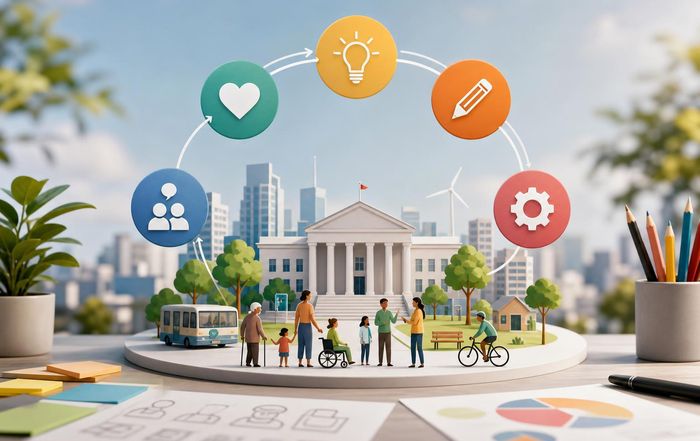
Institutions such as Stanford d.school explain design thinking as a process that typically includes stages like empathizing with users, defining the problem, ideating, prototyping, and testing. Readers can explore a foundational overview through resources from Stanford d.school and the Interaction Design Foundation, which provides extensive material on design thinking in practice. In the public sector, these stages are adapted to account for complex regulations, political accountability, and diverse constituencies. Rather than designing for a single customer segment, public servants must consider entire populations, including marginalized groups who may not have a strong voice in traditional policy processes.
The OECD Observatory of Public Sector Innovation (OPSI) has documented how design methods can help governments move from top-down, rule-driven approaches to more adaptive, citizen-centric models. Its reports on innovation in government highlight that design thinking is not simply a workshop technique but a way of working that can influence legislation, budgeting, and long-term strategy. For the loyal subscribers and also new online visiting readers who follow the always updated business innovation as well as public policy, this convergence of design, management, and governance is a sign that the boundaries between public and private problem-solving are gradually softening.
Why Public Services Need Design Thinking Now
Across continents, public services face similar structural challenges: aging populations in Japan, Italy, and Germany; rapid urbanization in parts of Asia, Africa, and South America; climate-related shocks in regions from Australia to South Africa; and economic inequality in both high-income and low-income countries. Traditional policy-making, which often relies on long planning cycles and top-down implementation, can struggle to keep pace with these shifting realities.
Research by the World Bank on service delivery and governance emphasizes that reforms frequently fail because they do not account for actual user experience. For example, a health insurance program may look sound on paper yet remain underused because enrollment is too complex or citizens do not trust the system. Similarly, digital tax filing systems may be technically robust but alienate users if interfaces are confusing or support is hard to access. Design thinking addresses these gaps by bringing the lived experience of residents into the center of policy design, testing ideas quickly, and learning from failure in a structured way.
Public innovation labs in countries as diverse as Denmark, Singapore, Canada, and the United Arab Emirates have demonstrated that design-led approaches can reduce administrative burdens, improve satisfaction, and increase uptake of services. The MindLab initiative in Denmark, which was active until it was restructured into new innovation units, was one of the early pioneers and its work is often cited by the Nesta innovation foundation in the United Kingdom, which publishes case studies on public sector innovation. While specific outcomes vary, meta-analyses by organizations such as Nesta and the OECD suggest that design methods are particularly effective in areas where user behavior is central, such as healthcare, employment services, and urban mobility.
For readers interested in how these changes affect everyday life, the link to lifestyle and health is direct: when systems are designed around real human needs, people spend less time navigating bureaucracy and more time focusing on wellbeing, family, work, and personal growth.
Core Methods: From Empathy to Prototyping
While different institutions use different labels, certain design thinking methods have become widely recognized in public service innovation.
One foundational method is deep user research through interviews, ethnographic observation, and journey mapping. Rather than relying solely on surveys or aggregate data, design teams spend time with residents, frontline staff, and community organizations to understand how they actually experience a service. The UK Government Digital Service (GDS), which transformed many national digital services, has documented its approach to user research in government, emphasizing that even basic observation of how people complete forms or navigate websites can reveal barriers that are invisible in statistics.
Another core method is co-creation, where citizens, civil servants, and sometimes businesses or non-profits collaborate in workshops to generate ideas and prioritize solutions. The European Commission has promoted co-creation through its projects on public sector innovation and design for policy, noting that involving users early can improve both the quality and legitimacy of decisions. For WorldsDoor readers who value culture and community, co-creation also resonates as a way to honor local knowledge and diverse perspectives rather than imposing one-size-fits-all solutions.
Prototyping and testing represent another crucial set of methods. Instead of developing a full-scale program and launching it nationwide, design-led teams create simple mock-ups, pilot programs, or limited trials. These can range from paper forms tested with a small group to digital prototypes or temporary service centers. The Harvard Kennedy School's Government Performance Lab and the Bloomberg Center for Public Innovation at Johns Hopkins University have both highlighted the value of iterative testing in municipal innovation, documenting examples on their respective sites, including city innovation case studies that show how prototypes help reduce risk while encouraging creativity.
Underpinning all these methods is a commitment to continuous learning. Design thinking does not assume that the first solution is the final one; instead, it treats every implementation as an opportunity to gather feedback, measure impact, and refine the approach. This mindset aligns well with evidence-based policy, as advocated by organizations such as the Campbell Collaboration and national evaluation offices that encourage governments to use robust data when assessing programs.
International Examples of Design-Led Public Services
Around the world, governments and public institutions are applying these methods in ways that reflect their specific cultural, political, and economic contexts. While not every initiative succeeds, the overall pattern shows a gradual mainstreaming of design thinking in public administration.
In the United Kingdom, the Government Digital Service is frequently cited as a model for user-centered digital transformation. Its work on services such as passport applications, vehicle tax, and voter registration has been recognized for simplifying processes and improving accessibility. Independent assessments by organizations like the Institute for Government discuss the broader impact of digital government reforms. While challenges remain, including legacy IT systems and funding constraints, the UK experience demonstrates how design principles can be embedded at scale.
In Singapore, the government's focus on citizen experience has led to initiatives such as the ServiceSG centers, which aim to offer integrated, user-friendly access to multiple services. Singapore's public sector innovation efforts are documented by the Public Service Division and the Centre for Public Service Innovation, which share resources on design thinking in public service and emphasize cross-agency collaboration. Observers note that Singapore's relatively centralized system can facilitate coordinated design efforts, though it also requires careful attention to citizen feedback to maintain trust.
In Canada, the Canada School of Public Service and various federal departments have invested in training public servants in design methods, while provincial and municipal governments experiment with new approaches to healthcare, transport, and social services. The MaRS Discovery District in Toronto, for example, runs programs on public and social innovation that connect design practitioners with policymakers and community leaders. Evaluations by academic institutions and independent think tanks suggest that design methods have helped improve service accessibility and responsiveness in areas such as digital identity and benefits delivery.
In Denmark, Finland, and other Nordic countries, design thinking is often integrated with long-standing traditions of social welfare and participatory governance. Institutions like Sitra in Finland, a national innovation fund, have produced research on human-centered public services and experimented with new models of elder care, education, and circular economy initiatives. These countries are frequently referenced in comparative studies by the OECD and the United Nations Department of Economic and Social Affairs, which publishes the UN E-Government Survey to track digital government progress.
For WorldsDoor readers who follow travel and global culture, these examples also offer a lens through which to experience cities and countries. When visitors encounter well-designed public transport systems in Tokyo or Seoul, streamlined immigration processes in Australia, or inclusive public spaces in Barcelona, they are often seeing the results of design-led policies that prioritize user experience, accessibility, and environmental sustainability.
Health, Lifestyle, and Wellbeing: Design Thinking in Human Services
Health and wellbeing are central concerns for many readers, and design thinking has made particularly visible contributions in this domain. Public health systems in countries such as United States, United Kingdom, Brazil, and Thailand have engaged designers to improve everything from appointment booking to chronic disease management.
The World Health Organization (WHO) has recognized the value of human-centered design in health programs, especially in low- and middle-income settings where barriers to access can be high. Its publications on people-centered health services note that involving patients, families, and communities in the design of services can improve adherence to treatment, reduce stigma, and enhance outcomes. For example, design methods have been used to reconfigure clinic waiting areas, simplify consent forms, and develop communication campaigns that resonate with local cultural norms.
In the United States, initiatives such as the Veterans Experience Office within the U.S. Department of Veterans Affairs have applied journey mapping, co-creation, and digital prototyping to improve services for veterans. Publicly available case studies show how redesigning appointment systems and benefit applications, based on extensive user research, has led to measurable improvements in satisfaction. Independent evaluations by organizations like the Partnership for Public Service and academic researchers provide additional context and highlight both successes and ongoing challenges.
On a more local scale, cities and regions have used design thinking to address lifestyle-related health issues such as obesity, mental health, and social isolation. For instance, urban design interventions like walkable streets, accessible parks, and community hubs, often informed by participatory design processes, connect directly to the themes of health, lifestyle, and environment that are central to WorldsDoor. Organizations like Gehl in Denmark, known for its work on human-centered cities, document examples of public space design for wellbeing where residents are engaged in shaping their own neighborhoods.
Environment, Sustainability, and Climate-Resilient Services
As climate change intensifies, public services must adapt to new environmental realities, from heatwaves in Europe to floods in Asia and wildfires in North America and Australia. Design thinking is increasingly used to co-create climate-resilient infrastructure, emergency response systems, and sustainable mobility.
The C40 Cities Climate Leadership Group highlights numerous examples of cities that have used participatory design and innovation challenges to develop green transport, energy-efficient buildings, and nature-based solutions. Its profiles of climate action in cities show how design methods help align technical planning with residents' daily lives. Similarly, the Ellen MacArthur Foundation promotes circular economy initiatives that often rely on design thinking to reimagine waste management, product lifecycles, and urban metabolism, documented in its circular economy case studies.
For WorldsDoor readers who care deeply about sustainable living, the intersection between design, environment, and public services is especially relevant. When municipalities introduce bike-sharing schemes, redesign bus routes, or create incentives for energy-efficient housing, they are not only implementing policy but also designing new patterns of daily life. The sustainability section of WorldsDoor often intersects with these themes, illustrating how local initiatives contribute to global climate goals.
In some regions, design thinking has been used to co-create disaster preparedness plans with communities, ensuring that evacuation routes, communication systems, and relief centers reflect local knowledge and cultural practices. The International Federation of Red Cross and Red Crescent Societies (IFRC) and the United Nations Office for Disaster Risk Reduction (UNDRR) both emphasize the importance of community engagement in disaster risk reduction, which aligns closely with design principles of empathy and co-creation.
Technology, Data, and the Ethics of Design in Government
Digital technologies and data analytics have become central to public service delivery, from e-government portals to AI-assisted decision-making. Design thinking plays a crucial role in ensuring that these technologies are deployed in ways that are understandable, inclusive, and ethically sound.
Organizations such as the World Economic Forum and the Ada Lovelace Institute have published frameworks on responsible AI and data use in the public sector, highlighting concerns about bias, transparency, and accountability. Design methods can help address these issues by involving affected communities in the design of algorithms and interfaces, conducting usability testing with diverse user groups, and making complex systems more legible through clear communication.
In many countries, digital identity systems, online voting pilots, and AI-supported welfare assessments have sparked debates about privacy and fairness. While design thinking cannot resolve all ethical dilemmas, it can ensure that user perspectives are systematically considered and that trade-offs are openly discussed. This aligns with the values explored in WorldsDoor's coverage of ethics and technology, where questions of trust and legitimacy are as important as efficiency.
Open data initiatives, which make government datasets accessible to the public, also benefit from design thinking. Platforms that are co-designed with civil society organizations, journalists, and researchers tend to be more usable and impactful. The Open Data Charter and the Open Government Partnership document numerous examples of open government reforms where design and collaboration improve both transparency and service quality.
Education, Culture, and Building Design Capacity in Government
For design thinking to have lasting impact in public services, governments need to build internal capacity rather than relying solely on external consultants. This involves training civil servants, updating curricula in schools of public administration, and fostering a culture that values experimentation and learning.
Universities and training institutes in countries such as Canada, Germany, Singapore, and the United States have introduced courses on public sector innovation and human-centered design. Institutions like the Harvard Kennedy School, University College London, and the Lee Kuan Yew School of Public Policy integrate case studies and practical projects into their programs, preparing future leaders to apply design methods in complex political environments. Online learning platforms, including those of the United Nations System Staff College and various national civil service academies, offer accessible introductions to innovation in governance.
Culturally, design thinking encourages a mindset that is curious, empathetic, and open to diverse perspectives. This resonates strongly with the cross-cultural sensibility that WorldsDoor promotes through its coverage of culture, education, and world topics. When public servants are trained to listen deeply to communities, understand different cultural norms, and co-create solutions, they are better equipped to serve multicultural societies in cities like London, Toronto, Sydney, Berlin, and Johannesburg.
Several governments have established internal design units or "policy labs" that act as hubs for training and experimentation. Examples include the UK Policy Lab, the Chile Government Lab, and various city-level innovation teams supported by Bloomberg Philanthropies. Independent evaluations suggest that while these labs often face challenges in sustaining funding and political support, they contribute significantly to building skills and spreading design practices across agencies.
Challenges, Limitations, and the Path Forward
Despite its promise, design thinking in public services is not a cure-all. Critics caution that design workshops can become superficial exercises if not backed by genuine commitment, resources, and structural reforms. Academic studies, including those published in journals such as Public Administration Review and Policy & Politics, note that power imbalances, bureaucratic inertia, and political cycles can limit the impact of design initiatives.
There is also a risk that design language is adopted without meaningful citizen participation, leading to "participation fatigue" when residents are repeatedly consulted but see little tangible change. To avoid this, experts emphasize the importance of transparent communication about what can and cannot be changed, clear feedback loops, and long-term partnerships with community organizations. The OECD and UNDP both advocate for inclusive governance approaches that integrate design thinking with broader democratic reforms, such as participatory budgeting and deliberative assemblies.
Measurement of impact remains another complex area. While some design-led projects can show clear improvements in metrics like processing time, satisfaction scores, or cost savings, others produce more qualitative benefits that are harder to quantify, such as increased trust or social cohesion. Researchers are working on better evaluation frameworks that combine quantitative data with qualitative insights, and organizations like the Alliance for Useful Evidence promote better use of evidence in policy.
Yet, even with these limitations, the trajectory of design thinking in public services is broadly positive. As more case studies are documented, more public servants trained, and more citizens engaged, the methods become more sophisticated and better adapted to the specific constraints of government. This evolution reflects a deeper shift toward seeing residents not as passive recipients of services but as partners in shaping the systems that affect their lives.
A More Human-Centered Future for Public Services
For the very well travelled, and thankfully quite intelligent community visiting WorldsDoor, design thinking in public services offers a hopeful narrative at a time when trust in institutions is under strain in many countries. It suggests that even large, complex systems can become more responsive, empathetic, and effective when they are designed with, rather than merely for, the people they serve.
Travelers observing seamless public transport in Netherlands, inclusive cultural programs in Canada, or digital government portals in Estonia are witnessing the tangible outcomes of this shift. Residents who participate in local co-design workshops, contribute to open data projects, or provide feedback on digital services are part of a broader movement toward more participatory, evidence-informed governance. The themes that WorldsDoor explores across health, travel, environment, innovation, and society all intersect in this space, where everyday experiences and institutional reforms meet.
As space and time unfold and new challenges emerge-from technological disruption to climate shocks and demographic shifts-the demand for creative, humane, and trustworthy public services will only grow. Design thinking does not replace the need for sound economics, legal frameworks, or political debate, but it adds a vital layer: the disciplined practice of understanding people's real lives and building systems that honor their complexity. For those who care about the future of cities, communities, and the shared world that WorldsDoor aims to illuminate, this human-centered approach offers not only daily updated practical tools and educational content but also a vision of governance grounded in empathy, collaboration, and continuous learning.