

How Volunteering Strengthens Local Communities
Volunteering has long been a quiet force behind resilient neighborhoods and thriving cities, yet in an era defined by rapid technological change, demographic shifts, and global uncertainty, its role has become both more complex and more essential. Around the world, from small towns in Canada and Germany to major hubs such as New York, London, Singapore, and São Paulo, citizens are rediscovering volunteering not only as an act of generosity, but as a strategic way to build healthier, more connected, and more sustainable communities. As WorldsDoor continues to explore how people shape their world through everyday choices, volunteering stands out as one of the clearest examples of how individual action can generate collective strength.
The Changing Landscape of Volunteering
In 2026, volunteering is no longer confined to traditional charity work or occasional neighborhood clean-ups, although those activities remain important. Research from organizations such as the United Nations Volunteers (UNV) programme and the Organisation for Economic Co-operation and Development (OECD) shows that formal volunteering through nonprofits and informal volunteering within families, neighborhoods, and online networks together contribute billions of hours of unpaid work each year, supporting services that governments and markets alone cannot provide. Readers who wish to explore global patterns can review recent analyses from UN Volunteers and OECD social policy reports, which highlight how volunteer efforts underpin social cohesion, disaster response, education, and healthcare.
Digital platforms have also transformed how people engage. Virtual volunteering, micro-volunteering, and skills-based volunteering allow professionals in cities like Sydney, Berlin, or Tokyo to mentor students in rural regions, support open-source health tools, or contribute to climate data projects without leaving home. Organizations such as VolunteerMatch and Idealist have documented rising interest in flexible, skill-oriented opportunities that fit into busy lives, and readers can explore these evolving models through resources like VolunteerMatch and Idealist. Yet even as volunteering becomes more digital and cross-border, its most powerful effects are often felt at the local level, where neighbors work side by side and see tangible changes in their streets, schools, and public spaces.
Building Social Connection and Trust
One of the most significant ways volunteering strengthens communities is by cultivating social connection and trust across lines of age, culture, and socioeconomic status. Social scientists frequently refer to this as "social capital," a term popularized by scholars such as Robert Putnam, whose work on community engagement has influenced policymakers in the United States, Europe, and beyond. While specific numbers may vary by country, studies summarized by organizations like the World Health Organization (WHO) and the Harvard T.H. Chan School of Public Health indicate that people with strong social networks and a sense of belonging tend to experience better physical and mental health outcomes. Those interested in the public health perspective can explore reports on social connection from WHO and research summaries from Harvard Chan School.
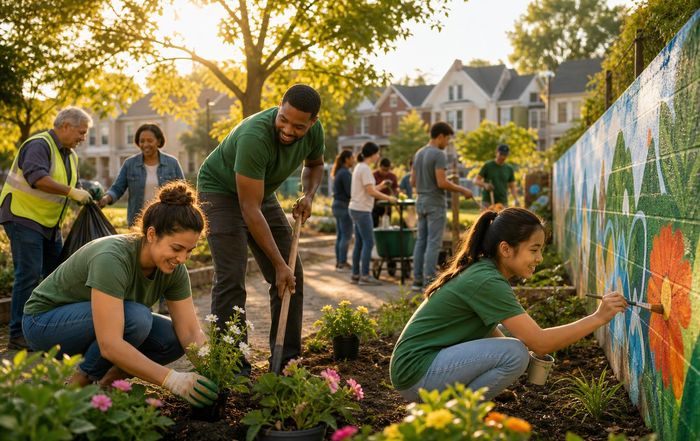
In many cities, volunteer-led initiatives such as community gardens, neighborhood festivals, and cultural exchange programs create spaces where people who might never otherwise meet can collaborate on common goals. A community garden in Rotterdam or Vancouver, for instance, can bring together retirees, recent immigrants, university students, and families with young children, all working side by side to grow food and beautify shared land. Over time, repeated contact and cooperation help build trust, reduce prejudice, and foster a sense of shared identity that transcends political or cultural divides. This type of bridging social capital is especially valuable in multicultural societies such as Canada, the United Kingdom, or Singapore, where diversity is a strength but also requires intentional effort to maintain cohesion.
For WorldsDoor readers interested in how culture and society intersect in these spaces, features on culture and society highlight how volunteering can become a form of cultural diplomacy at the neighborhood level. When volunteers organize language exchanges, food festivals, or storytelling circles, they are not simply offering a service; they are creating a shared narrative of community that can reduce isolation and counter polarization.
Enhancing Physical and Mental Health
Volunteering does not only benefit the recipients of services; it also significantly supports the health and wellbeing of volunteers themselves, which in turn strengthens local communities by creating more resilient, engaged residents. Research from institutions such as Mayo Clinic and Cleveland Clinic has found associations between regular volunteering and lower rates of depression, reduced stress, and improved life satisfaction, especially among older adults. Interested readers can review accessible overviews from Mayo Clinic and Cleveland Clinic, which describe how purposeful activity, social interaction, and physical movement contribute to better health outcomes.
In cities across Europe, North America, and Asia, hospitals and public health agencies increasingly partner with volunteer organizations to support patient care, provide companionship for seniors, and extend health education into communities that might otherwise be underserved. For example, volunteer "health navigators" in neighborhoods in London or Los Angeles help residents understand medical information, connect with clinics, and adopt healthier lifestyles. These roles are often coordinated with local health departments and community-based organizations to ensure appropriate training and oversight.
From the perspective of WorldsDoor, which regularly explores wellbeing and lifestyle trends, volunteering can be seen as a form of proactive self-care that benefits both the individual and the community. Articles in the health and lifestyle sections increasingly highlight how purpose, connection, and contribution are as crucial to wellbeing as diet or exercise. When residents in cities like Stockholm, Melbourne, or Seoul integrate volunteering into their weekly routines, they not only support local services but also cultivate a sense of meaning that can protect against burnout and loneliness.
Strengthening Local Economies and Skills
While volunteering is unpaid by definition, its economic impact on local communities is substantial. Analysts at organizations such as Johns Hopkins University's Center for Civil Society Studies and Charities Aid Foundation (CAF) have documented how volunteers contribute to local economies by supporting services that would otherwise require public funding, enhancing the capacity of nonprofits, and building skills that improve employability. Readers can explore broader trends in civil society and philanthropy through resources like Johns Hopkins Center for Civil Society Studies and Charities Aid Foundation.
In many countries, volunteers support local tourism, cultural events, and environmental projects that attract visitors and investment. Festivals in Edinburgh, Montreal, or Kyoto often rely on volunteer teams to manage logistics, provide information, and create welcoming experiences for international guests. This not only reduces operational costs but also offers local residents opportunities to develop language skills, event management experience, and cross-cultural competencies that are valuable in increasingly global labor markets.
Skills-based volunteering has grown particularly rapidly, with professionals in fields such as technology, marketing, law, and finance offering their expertise to small nonprofits and social enterprises. Platforms and initiatives supported by organizations like TechSoup and Taproot Foundation help match skilled volunteers with organizations that need support in areas such as digital transformation, strategic planning, or legal compliance. Those interested in this trend can learn more from TechSoup and Taproot Foundation, which provide case studies and guidance for both volunteers and host organizations.
For younger volunteers in countries such as Germany, South Africa, or Brazil, community service can also serve as a bridge into the workforce, offering practical experience, references, and networking opportunities. Universities in Canada, the United States, and several European countries increasingly incorporate service-learning components into degree programs, blending academic study with structured volunteering. This aligns with themes explored in WorldsDoor's new coverage of education, where experiential learning and civic engagement are presented as key to developing adaptable, socially conscious graduates.
Protecting the Environment and Supporting Sustainable Living
Environmental volunteering has become one of the most dynamic and visible forms of civic engagement, particularly among younger generations concerned about climate change, biodiversity loss, and pollution. From beach clean-ups in Thailand and Australia to urban tree-planting in Paris and Toronto, volunteers play a crucial role in protecting local ecosystems and promoting sustainable lifestyles. Environmental organizations such as Greenpeace, World Wildlife Fund (WWF), and The Nature Conservancy regularly highlight volunteer-led projects that restore habitats, monitor species, and advocate for policy change. Readers can explore these initiatives through resources like WWF and The Nature Conservancy.
Local environmental volunteering often has immediate, tangible benefits for communities. Restored wetlands can reduce flood risks in coastal regions, urban greening projects can lower temperatures during heatwaves in cities like Madrid or Phoenix, and community composting initiatives can reduce waste and support local food systems. These projects also provide educational opportunities for children and adults, helping residents understand how global environmental issues intersect with the health of their own neighborhoods.
Within WorldsDoor, environmental and sustainability themes are woven throughout coverage in sections such as environment and sustainable, where readers can learn more about sustainable business practices, regenerative agriculture, and circular economy initiatives. Volunteering often serves as an accessible entry point into these broader conversations, allowing individuals to move from concern to action. When residents in Copenhagen, Nairobi, or Buenos Aires join local climate resilience projects or citizen science initiatives, they not only contribute data and labor but also help shape local priorities and policies through their visible commitment.
Preserving Culture and Heritage
Local culture and heritage are strengthened when community members invest time and energy into preserving and sharing their traditions, languages, and stories. Museums, historical societies, arts organizations, and cultural festivals across Europe, Asia, Africa, and the Americas rely heavily on volunteers to curate exhibits, guide tours, document oral histories, and organize performances. Institutions such as UNESCO emphasize the importance of community participation in safeguarding both tangible and intangible cultural heritage, and readers can explore these perspectives through UNESCO's culture programs.
In cities with layered histories such as Rome, Istanbul, or Cape Town, volunteers often collaborate with local historians, architects, and archivists to maintain historic buildings, catalog archives, and run educational programs for schools. These efforts ensure that cultural heritage is not only preserved in static form but remains a living, evolving part of community identity. For immigrant and minority communities in countries like the United States, the United Kingdom, or Sweden, volunteer-led cultural centers, language schools, and arts collectives provide vital spaces where younger generations can connect with their roots while building bridges to the broader society.
WorldsDoor frequently highlights how travel and culture intertwine, and volunteering can be a powerful lens through which to explore this connection. Articles in the travel and culture sections often emphasize respectful engagement with local communities, encouraging readers to move beyond passive tourism toward more reciprocal experiences. Cultural volunteering, whether through assisting at a local festival in Lisbon or helping document traditional crafts in rural Japan, allows travelers and residents alike to participate in the stories that make each place unique.
Fostering Innovation and Community-Led Solutions
Contrary to the perception that innovation is driven primarily by large corporations or research institutions, many community-level innovations emerge from volunteer networks responding creatively to local challenges. During crises such as natural disasters, public health emergencies, or economic downturns, volunteers frequently experiment with new models of mutual aid, digital coordination, and resource sharing. Academic and policy analyses from institutions like MIT's Community Innovators Lab and Stanford's Center on Philanthropy and Civil Society have documented how grassroots initiatives can pioneer approaches later adopted by governments or nonprofits. Those interested in this dimension can explore insights from MIT CoLab and Stanford PACS.
In many cities, volunteer-led makerspaces, repair cafés, and community labs encourage residents to experiment with low-cost technologies, circular economy practices, and open-source tools. These spaces, often supported by local universities or municipal governments, allow people of different ages and backgrounds to collaborate on solutions ranging from air quality monitoring to urban mobility. The global Repair Café movement, for example, illustrates how volunteers with technical skills can help neighbors extend the life of household items, reducing waste while building community knowledge.
Within WorldsDoor's focus on innovation and technology, volunteering appears as a catalyst that democratizes innovation, enabling people who may not have formal R&D budgets or corporate backing to test ideas and share them widely. When local volunteers in Nairobi develop community Wi-Fi networks, or when residents in Amsterdam use open data to map accessibility challenges, they demonstrate that innovation is not solely the domain of experts but can flourish wherever people are empowered to act.
Encouraging Ethical Engagement and Responsible Travel
As volunteering has expanded, particularly across borders, questions of ethics and impact have become more prominent. Debates around "voluntourism," for instance, have highlighted the potential harms of poorly designed short-term projects, especially in sensitive areas such as orphanage care, wildlife interactions, or construction work that displaces local labor. Organizations such as UNICEF and Save the Children have cautioned against certain forms of volunteering that may unintentionally exploit vulnerable populations, and interested readers can explore these concerns through resources from UNICEF and Save the Children.
Responsible volunteering requires careful consideration of power dynamics, local leadership, and long-term sustainability. Ethical guidelines emphasize that the most effective projects are those initiated and led by local communities, with volunteers playing supportive roles that transfer skills, respect local knowledge, and avoid creating dependency. For travelers from regions such as North America, Europe, or Australia who wish to contribute while abroad, it is increasingly recommended to partner with organizations that prioritize community consent, transparency, and measurable outcomes.
WorldsDoor seeks to support this more thoughtful approach by integrating ethical frameworks into its coverage of travel, ethics, and world issues. Readers are encouraged to ask critical questions about any volunteer opportunity: Who defined the need? How are local people involved in decision-making? What happens after volunteers leave? By treating volunteering not as charity but as a partnership, individuals can help ensure that their contributions genuinely strengthen local communities rather than inadvertently causing harm.
Inspiring a Culture of Participation
Ultimately, the power of volunteering lies not only in specific projects or measurable outcomes, but in the broader culture of participation it nurtures. When people in cities from Toronto to Tokyo, Cape Town to Copenhagen, view themselves as active co-creators of their communities rather than passive consumers of services, they become more likely to vote, attend public meetings, support local businesses, and engage in constructive dialogue about shared challenges. Civic participation, in this sense, is contagious; seeing neighbors volunteer at a local school, food bank, or environmental project often inspires others to get involved.
Media platforms updated each day such as WorldsDoor play a role in amplifying these stories and making them visible across borders. By highlighting examples of community resilience, cultural preservation, environmental stewardship, and social innovation driven by volunteers, WorldsDoor invites readers to imagine what is possible in their own neighborhoods, whether they live in a small town in Finland, a bustling district in Bangkok, or a growing city in South Africa. Features spanning food, environment, business, and more demonstrate that volunteering intersects with nearly every aspect of life, from how people eat and move to how they learn, work, and celebrate.
As societies navigate the complexities of the mid-2020s, including climate pressures, technological disruptions, and shifting demographics, the quiet, consistent work of volunteers offers a source of stability and hope. Every hour spent mentoring a child, restoring a riverbank, preserving a local archive, or supporting a community health initiative contributes to a tapestry of resilience that cannot easily be quantified but is deeply felt. In this way, volunteering continues to strengthen local communities not only by filling gaps in services, but by affirming a shared belief that collective action is both possible and worthwhile.
For readers and followers exploring the world through WorldsDoor, the invitation is clear: consider how talents, time, and passions might align with the needs and aspirations of local communities, whether close to home or across borders. By stepping through that door into active participation, individuals join a global movement of people who are quietly, persistently shaping a more connected, compassionate, and sustainable world.