

How to Plan a Cycling Holiday in the Netherlands
Cycling in the Netherlands is less a leisure activity than a way of life. That makes it one of the easiest countries in the world for a bike-based trip, but the abundance of routes, regions, and options can also be overwhelming for first-time visitors. Planning a cycling holiday here is partly about choosing where to ride, and partly about understanding how Dutch cycling infrastructure, culture, and rules work so you can move around confidently.
This road wise guide walks through the main decisions: when to go, which regions to choose, how to use the national cycle network, what kind of bike and luggage system you need, safety and rules of the road, and how to connect your trip with trains, cities, and even other parts of Europe.
Understanding Dutch cycling culture and infrastructure
The Netherlands has more bicycles than people and one of the highest cycling mode shares in the world. That is not just a statistic; it shapes how a cycling holiday feels on the ground. Dedicated cycle paths, traffic-calmed streets, and bike-priority junctions mean that much of your route will be separated from traffic or on roads where cars are guests. This is especially true in and around cities like Amsterdam, Utrecht, and Groningen, but even rural areas have well-marked, paved bike paths linking villages, nature reserves, and coastal dunes.
For planning, it helps to know a few structural elements. The national government and provinces coordinate infrastructure through bodies such as Rijkswaterstaat and local municipalities, while organizations like Fietsersbond (the Dutch Cyclists' Union) and ANWB (the Royal Dutch Touring Club) provide maps, route suggestions, and advocacy. The result is a dense mesh of signed routes, including the numbered junction system (knooppunten), long-distance LF-routes, and themed regional trails. Visitors do not need to be expert cyclists to use them, but it is worth spending time before arrival learning how the signage works.
Dutch cycling culture is also pragmatic. Locals ride in regular clothes, often on upright city bikes, and treat cycling as transport rather than sport. That means you will share paths with commuters, families with children, and older riders on e-bikes. Tourists on heavily loaded touring bikes or in full Lycra are a minority outside of sport routes. Adapting to local norms-riding predictably, signaling clearly, and not blocking paths when stopping-will make your trip smoother and more enjoyable, and helps maintain the positive relationship between visitors and residents.
For broader context on Dutch transport and urban planning, official sites such as the Government of the Netherlands at https://www.government.nl/ and international bodies like the Organisation for Economic Co-operation and Development offer background on how cycling fits into national mobility and climate strategies. Understanding that broader picture can enrich a holiday that is as much about culture and society as it is about scenery.
When to go: seasons, weather, and crowds
The Netherlands has a temperate maritime climate, with relatively mild winters and cool summers. For most visitors planning a cycling holiday, the most comfortable months are late April to mid-October. Within that window, each period has a distinct character that can shape your route and expectations.
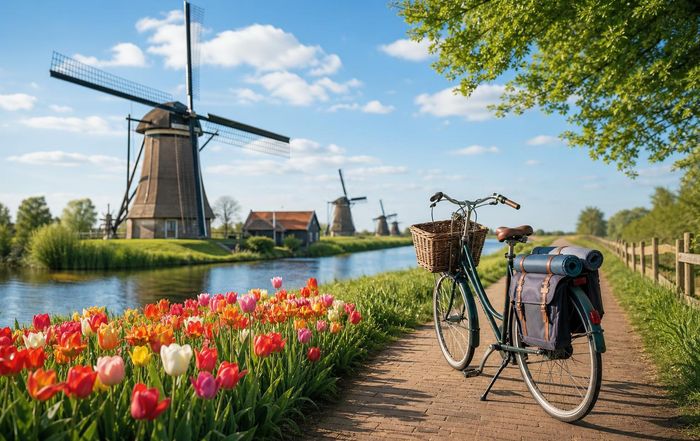
Late April and May bring spring flowers and, in some years, famous tulip fields in regions such as the Bollenstreek and parts of Flevoland. Temperatures are often cool but pleasant for cycling, and days are already long. However, this is also a peak time for tourism around Keukenhof and nearby towns, so accommodation near major flower attractions may require advance booking. For general travel patterns and climate information, national meteorological services such as KNMI and broader resources like the World Meteorological Organization provide reliable data on average rainfall, temperature, and wind.
Summer, from June through August, offers the warmest weather and the longest days, making it ideal for extended rides and late-evening exploration of cities. Coastal areas such as Zeeland and the Wadden Islands can be particularly appealing, with dunes, beaches, and sea breezes providing natural variety. This is also school-holiday season, so family tourism increases, especially in coastal and lake districts. Campsites and popular holiday parks may fill up, but the dense accommodation network still makes it possible to improvise if you are flexible.
September and early October are often underrated. Temperatures remain moderate, tourist numbers drop, and autumn colours appear along canals and in forests such as the Veluwe. Rain probability rises slightly, but with appropriate clothing this period can be one of the most rewarding for longer touring days. Winter cycling holidays are possible for experienced riders comfortable with colder, wetter conditions and shorter daylight hours, but they require more robust gear and flexible plans. For health-related considerations around exertion in different climates, organizations such as the World Health Organization and national health ministries offer general guidance on physical activity and weather exposure that can be adapted to your own needs.
Regardless of season, wind is a defining feature of Dutch cycling. The country is flat, but headwinds can make distances feel longer. When planning multi-day routes, consider typical prevailing winds (often from the southwest) and, where feasible, design itineraries that avoid riding long straight stretches directly into the wind all day.
Choosing your region: coast, cities, and countryside
Although the Netherlands is compact, its regions offer distinct cycling experiences. Selecting one or two main areas, rather than trying to see the entire country in a single trip, usually leads to a more relaxed and immersive holiday.
The western Randstad region-encompassing Amsterdam, Rotterdam, The Hague, and Utrecht-is dense, urban, and culturally rich. Here, cycling holidays often combine city exploration with short hops into surrounding countryside and coastal dunes. For example, riders can base themselves in Amsterdam and follow signed routes to the Zaanstreek, Waterland, or the North Sea coast near Zandvoort, using the excellent local network of paths and ferries. Urban-oriented travellers interested in architecture, museums, and contemporary culture may find this region especially rewarding. For cultural planning, resources like Iamsterdam and national tourism platforms such as Netherlands Board of Tourism & Conventions are useful complements to cycling maps.
The northern provinces, including Friesland and Groningen, offer big skies, historic towns, and quieter roads. Friesland's lakes and waterways are popular for combined cycling and boating trips, while the Wadden Islands-such as Texel, Terschelling, and Ameland-are classic car-light destinations where cycling is the primary way to get around. These islands are particularly suitable for families or less experienced riders who prefer shorter daily distances and varied nature. To understand conservation and tidal ecology in this UNESCO-listed region, resources from organizations like UNESCO and the International Union for Conservation of Nature can add an environmental dimension to your trip.
In the east and centre, provinces like Gelderland and Overijssel feature forests, heathlands, and national parks such as De Hoge Veluwe. These areas suit travellers looking for more nature-heavy itineraries, with longer, quieter stretches away from dense urban cores. The south, including Limburg and North Brabant, introduces something many do not associate with the Netherlands: hills. South Limburg has rolling countryside and short climbs that attract road cyclists seeking more physical challenge, along with picturesque towns and cross-border routes into Belgium and Germany.
Wherever you choose, consider how cycling fits alongside other interests-food, history, contemporary culture, or environmental themes. For example, readers interested in sustainable travel can connect their route planning with broader coverage of responsible tourism and climate issues via guides such as the sustainability section on worldsdoor.com/sustainable, while those prioritizing cultural immersion might combine rides with insights from worldsdoor.com/culture.
Navigating with the knooppunten and LF routes
The Dutch route-planning system is one of the country's great gifts to visiting cyclists. At its core is the knooppunten (junction) network: a grid of numbered intersections connected by signed paths. Each junction has a number, and signposts show the direction and distance to neighbouring numbers. Planning a route becomes as simple as creating a sequence of numbers-say, 12-18-24-30-and following the white-and-green signs along the way.
This system is particularly friendly for travellers who prefer flexible, day-by-day planning. Many riders jot down or photograph a list of junction numbers before leaving their accommodation, or note them on a handlebar-mounted card. Tourist information offices, bike shops, and some hotels sell regional knooppunten maps, and digital platforms maintained by Dutch tourism bodies and cycling organizations allow you to plan online. While there are numerous commercial apps and mapping tools, official and semi-official sources such as the ANWB at https://www.anwb.nl/ and the national tourism portal at https://www.holland.com/ are reliable starting points and often integrate up-to-date route information.
For longer-distance touring, the LF-routes (Landelijke Fietsroutes) form a backbone network of multi-day trails across the country. These routes are being modernized into LF-icon routes-such as LF Zuiderzeeroute around the former Zuiderzee-each with a thematic character. While you can ride them end-to-end, many visitors use sections as a framework and connect them with knooppunten to reach specific towns or accommodations. National and regional governments, as well as cycling advocates like Fietsersbond at https://www.fietsersbond.nl/, provide digital route planners that integrate both networks.
GPS navigation is increasingly common, especially among sport and touring cyclists, but it is not essential. In fact, relying solely on GPS can sometimes be counterproductive if it tries to send you along busy roads that locals avoid. A hybrid approach-using knooppunten and LF routes as the primary structure, with offline maps on a phone for backup-is often best. For travellers who are new to route planning, introductory material on mapping and outdoor navigation from organizations like OpenStreetMap and general route-planning guides on Cycling UK can be helpful, even if they are not Netherlands-specific.
Renting or bringing a bike: types, e-bikes, and gear
One of the first practical decisions is whether to rent a bicycle in the Netherlands or bring your own. Each option has trade-offs related to cost, familiarity, and logistics. Bringing your own touring or road bike gives you a familiar fit and the ability to use your preferred luggage system. However, it also involves airline or train transport, potential fees, and the need to reassemble and pack the bike at each end of the trip. Renting locally avoids transport complexity and often includes basic maintenance support, but the available models may not match your ideal setup exactly.
Most Dutch rental fleets focus on upright city bikes (omafiets and similar), which are perfect for shorter distances on flat terrain and for riders who prioritize comfort and sightseeing over speed. For multi-day touring, many shops and specialized rental companies also offer trekking bikes with more gears, pannier racks, and sometimes dynamo lighting. E-bikes are widely available and increasingly popular among both locals and visitors. For travellers who want to cover more distance or who have varying fitness levels in a group, e-bikes can make a cycling holiday more inclusive. When renting an e-bike, pay attention to battery range and charging options at your accommodation; in most Dutch hotels and guesthouses, charging overnight is straightforward.
Helmet use is not mandatory for adults in the Netherlands and many locals ride without one, but visitors from countries with different norms may feel more comfortable wearing one, especially on higher-speed e-bikes or in hilly regions. Quality helmets are widely available in bike shops and sports stores. For health and safety guidance around cycling equipment, organizations such as Road Safety GB and NHTSA (for general helmet information) offer evidence-based perspectives, though legal requirements vary by country.
In terms of luggage, panniers mounted on front or rear racks are the standard choice for touring, as they keep weight low and stable. Bikepacking bags-frame, seat, and handlebar bags-are increasingly common among riders who prefer lighter setups and smaller accommodations. Whichever system you choose, waterproofing is important, as showers can arrive quickly even in summer. A basic tool kit, spare inner tube, pump, and lock are essential. Dutch towns are dense with bike shops, so catastrophic failures are rare, but having the means to fix a puncture on a canal path or in a forest will save time and stress.
For travellers planning longer routes that intersect with other transport modes, it can be helpful to think of the bike as part of a broader travel system that might also include trains, buses, and ferries. Guides on multimodal travel and sustainable mobility in the travel section of worldsdoor.com/travel and the environment-focused coverage at worldsdoor.com/environment can provide additional context for designing low-carbon itineraries.
Combining bikes with trains, ferries, and public transport
One of the strengths of a cycling holiday in the Netherlands is how easily bikes integrate with public transport. The national rail operator NS runs a dense network of trains connecting major cities and many smaller towns, and most intercity and regional services allow bicycles outside peak commuter hours with a supplemental bike ticket. This makes it possible to create one-way cycling itineraries-riding from city A to city B and returning by train-without worrying about retrieving a car or riding back along the same route.
Before travel, it is wise to review the latest rules on bike carriage from NS at https://www.ns.nl/, including restrictions during rush hours and on particular train types. Folding bicycles generally travel for free and are allowed at more times, which can be useful for visitors who plan extensive rail travel. For cross-border connections, international rail platforms such as Deutsche Bahn and SNCB/NMBS at https://www.belgiantrain.be/ provide information on bike policies for trains to Germany and Belgium, enabling extended tours that link Dutch routes with neighbouring countries.
Ferries, both large and small, are integral to Dutch cycling networks. In cities like Amsterdam and Rotterdam, free or low-cost ferries shuttle cyclists across rivers and canals, while in rural areas small foot-and-bike ferries connect dike paths, islands, and nature reserves. Services to the Wadden Islands, operated by companies such as Rederij Doeksen and TESO, accommodate bikes and are popular with holidaymakers. Schedules can vary by season, so checking timetables in advance is important, particularly if your daily distance assumes a specific crossing.
Buses have more limited capacity for full-size bikes but can be useful for specific segments, especially in regions without dense rail coverage. Local transport authorities and their websites, often linked from municipal portals on government.nl, provide details. In practice, many cycling holidaymakers rely primarily on trains and ferries, using buses only as backups.
This multimodal flexibility allows for creative itinerary design. For instance, travellers might start with a couple of nights in Utrecht, ride through the Green Heart to Leiden, continue along the coast to The Hague, and then take a train to the north for a loop through Groningen and Friesland, all within a week to ten days. For broader reflections on how such trips intersect with sustainable tourism and global mobility trends, the world and society sections at worldsdoor.com/world and worldsdoor.com/society offer complementary perspectives.
Rules of the road, safety, and etiquette
Cycling may feel informal in the Netherlands, but it operates within clear legal and social frameworks. Understanding these helps visitors ride safely and comfortably. Dutch traffic law gives substantial space and priority to cyclists, but it also expects them to follow rules. Basic requirements include riding on designated cycle paths where available, obeying traffic lights and signs, and using lights after dark or in poor visibility. Front lights must be white or yellow; rear lights red. Reflectors on pedals and wheels are common and recommended.
Alcohol and drug limits apply to cyclists as well as motorists, and police can and do enforce them. Mobile phone use while riding is also restricted; holding a phone in your hand while cycling is prohibited and can result in fines. Hands-free navigation via a handlebar mount or audio directions is acceptable, but riders remain responsible for maintaining attention to their surroundings. For authoritative information on traffic rules, official sources such as the Dutch government's portal at https://www.government.nl/ and road safety organizations like SWOV are valuable references.
Etiquette matters as much as formal rules. On cycle paths, riders generally keep to the right, overtake on the left, and use a bell or a brief verbal signal when passing. Stopping in the middle of a path to check a map or take photos is frowned upon; it is better to pull over to the side or onto a side street. In busy urban areas, especially in Amsterdam's centre, traffic can be dense and fast-moving; new visitors may want to start in quieter neighbourhoods or parks to get used to the flow before tackling major intersections.
While helmets are optional, visibility is always useful. Bright or reflective clothing, especially in low light or bad weather, helps other road users see you. For broader health and safety perspectives on active travel, international bodies such as the World Health Organization and European road safety platforms like ETSC provide evidence-based material that can inform personal risk decisions.
Insurance is another consideration. Travel insurance policies differ in how they handle cycling, especially for e-bikes, multi-day tours, or higher-speed road cycling. Checking the small print-whether cycling is classified as standard activity or a higher-risk sport-is important before departure. Readers interested in the intersection of travel, health, and risk management may find additional context in the health section at worldsdoor.com/health.
Accommodation, food, and daily distances
Because the Netherlands is dense with towns and villages, cycling holidays here rarely require extreme self-sufficiency. A wide range of accommodation-hotels, guesthouses, B&Bs, hostels, and campsites-caters to cyclists either explicitly or by default. Many properties offer secure bike storage, and some provide basic tools, route information, or packed lunches. Booking platforms and regional tourism boards list "fietsvriendelijk" (bike-friendly) accommodations, and organizations like Natuurkampeerterreinen and Staatsbosbeheer at https://www.staatsbosbeheer.nl/ manage nature campsites that appeal to travellers seeking quieter, more rural experiences.
Daily distance planning depends on fitness, terrain, and how much time you want to spend off the bike. On flat routes with good surfaces, many casual riders find 40-60 kilometres per day comfortable, leaving time for stops at museums, cafes, and nature reserves. More experienced or sport-oriented cyclists might aim for 80-120 kilometres, especially in summer with long daylight hours. E-bikes can extend these ranges, but it is wise to factor in battery range and charging opportunities.
Food is rarely far away. Supermarkets, bakeries, and cafes are common even in small towns, making it easy to assemble picnics or stop for coffee and cake. Traditional Dutch cycling staples include broodjes (sandwiches), apple pie, and pancakes, but urban centres now offer a wide variety of international cuisines and vegetarian or vegan options. For readers interested in culinary dimensions of travel, the food section at worldsdoor.com/food provides broader context on how gastronomy intersects with place and culture.
Hydration is straightforward: tap water is safe to drink across the country, and many public spaces have fountains. Refillable bottles and minimal single-use plastics align well with the Netherlands' broader environmental policies. For those who want to connect daily choices on the road with global sustainability issues, organizations such as the United Nations Environment Programme and the climate-focused coverage at worldsdoor.com/environment offer useful frameworks.
Building an itinerary: examples and practical tips
Turning all these elements into a concrete plan can feel daunting, so it helps to think in terms of themes and durations. A first-time visitor with a week to spare might choose a city-plus-countryside itinerary: two nights in Utrecht exploring its canals and museums, followed by a three-day loop through the Green Heart and along the Vecht river, then a train to Haarlem for coastal rides through the dunes and a final day trip into Amsterdam. Each segment uses the knooppunten network for flexible day rides of 40-60 kilometres, with trains bridging longer gaps.
Travellers with ten days or more could consider a coastal and islands route: starting near Rotterdam, following the North Sea cycle route through Zeeland's dikes and bridges, then heading north along the coast via The Hague and Alkmaar before taking a ferry to Texel. From there, a combination of island hopping, mainland segments, and trains can create a varied journey that balances nature, small towns, and occasional city days. Those with a stronger sport or hill focus might base themselves in South Limburg, riding loops that cross into Belgium's Ardennes or Germany's Eifel region, using regional trains to reposition as needed.
When assembling your own plan, it can be useful to sketch a high-level structure-entry and exit cities, rough regional focus, and total number of cycling days-before filling in daily routes. This prevents over-ambitious mileage targets and leaves room for rest days or weather contingencies. Resources from cycling organizations like Cycling UK and European tourism bodies such as Visit Europe offer general advice on pacing and rest that can be adapted to Dutch conditions.
Finally, consider how your cycling holiday fits into a broader approach to travel and lifestyle. For some, it may be a one-off adventure; for others, it can be the start of a shift towards more active, lower-carbon holidays. The lifestyle and innovation sections at worldsdoor.com/lifestyle and worldsdoor.com/innovation explore how changing technologies-such as e-bikes and digital route planning-are reshaping everyday mobility and leisure, offering a wider lens through which to view your time on Dutch roads and paths.
A cycling holiday in the Netherlands is ultimately about more than kilometres and maps. It is a way to experience a country that has built its towns, countryside, and public life around the bicycle. With a bit of advance planning-choosing the right season and region, understanding the knooppunten network, selecting appropriate bikes and gear, and learning local rules and etiquette-you can move through that landscape at a human pace, connecting cities, villages, and natural areas in a way that few other modes of travel allow.